Category Archives: Frieda’s Life

Translation Is Complete

The raw translation is complete, which means I now have a decent overview of the recipes in the notebook. There are a total of 121 unique recipes. They fall roughly into these categories: Beverages, Cakes and Torte, Candy, Cookies, Donuts and Pastries, Jams/Jellies/Preserves, Mousses/Parfaits/Ice Cream, Pancakes, Puddings, and a Miscellaneous category. I updated the recipe page with the full list.

It looks like my great-aunt might have been working in the castle’s kitchen long enough to master pastries and move on to learning other skills. Included in the notebook are recipes for preserves, pickles, wine, and pickled herring. There’s even one for making beer out of rock sugar. I think I should try tackling that one soon, since you have to let it stand for a couple of weeks before you can drink it. I can hardly wait for berry season though. I love making jam.

I also have another clue. The inside cover of the notebook has an inscription:
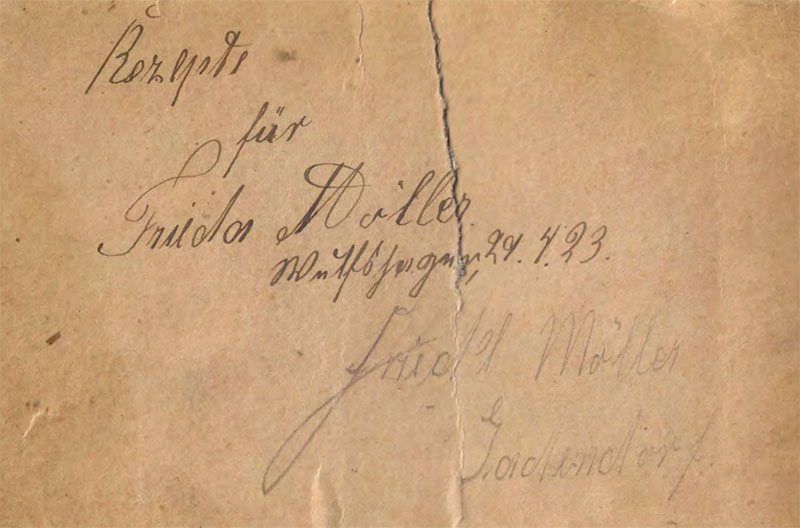
Inscription on inside cover of the notebook.

Inscription on inside cover: Recipes for Frieda Möller, Wulfshagen 29.4.23, Friedel Möller, Gadendorf.

Wulfshagen and Gadendorf are in the same part of Germany as the village where Aunt Frieda and my grandfather grew up. Clearly, narrowing down the location is going to take a lot more research. Both covers also contain dates—April 29, 1923 on the inside front cover and 1922 on the inside back cover. That means she would have been in her late teens when she worked there. If she was preparing jams and pickles she must have work through at least one summer, as well. Perhaps she started as a pastry cook in 1922 and worked her way up to canning and preserves by the summer of 1923?

 

Who Was The Castle Cook?

My parents recently celebrated their 50th wedding anniversary. In preparation for the big event, I asked my mom to send me family photos so I could prepare a memory book. Along with photos of camping trips, family reunions, and me in the bathtub when I was 2, came a bunch of old family photos—including this one of my dad’s grandparents and their family in front of their home in Germany in the 1920s.

Frieda and family c. 1927

Frieda Möeller (on right) with her parents, Magdelena and Ferdinand, an uncle, and her brother Henry, in front of their cottage in Krokaw, Germany. c. 1927.

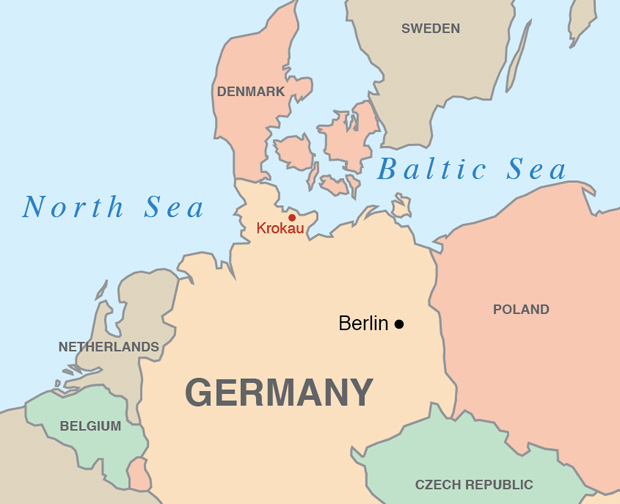
Map showing location of Krokau in Northern GermanyFrieda Möller grew up in Krokau, in a small village in the state of Schleswig-Holstein, not far from the Baltic Sea in Northern Germany. Krokau today has a population of 477 (according to Wikipedia) and I can’t imagine that it was much bigger back then.

When my grandfather, Henry, immigrated to the United States he found work as a farm hand and Krokau’s coat of arms depicts a windmill and water, so I imagine that Krokau was a coastal farming village. Since Frieda worked as a cook in a castle as a young woman, I also imagine that she had dreams of something bigger than staying on the farm. It was, after all, the 1920s during the Weimer Republic in Germany. Women were gaining more freedom. In 1918 they had even been given the right to vote.

So far all I have done is imagine what her life might have been like. It’s time to dig a little deeper. In December I won a three month’s subscription to Ancestry.com, through a charity auction put on by Solutions at Work. I think it’s time to roll up my sleeves, start asking questions, and put that subscription to use.