Author Archives: karenbeck

Who Was The Castle Cook?

My parents recently celebrated their 50th wedding anniversary. In preparation for the big event, I asked my mom to send me family photos so I could prepare a memory book. Along with photos of camping trips, family reunions, and me in the bathtub when I was 2, came a bunch of old family photos—including this one of my dad’s grandparents and their family in front of their home in Germany in the 1920s.

Frieda and family c. 1927

Frieda Möeller (on right) with her parents, Magdelena and Ferdinand, an uncle, and her brother Henry, in front of their cottage in Krokaw, Germany. c. 1927.
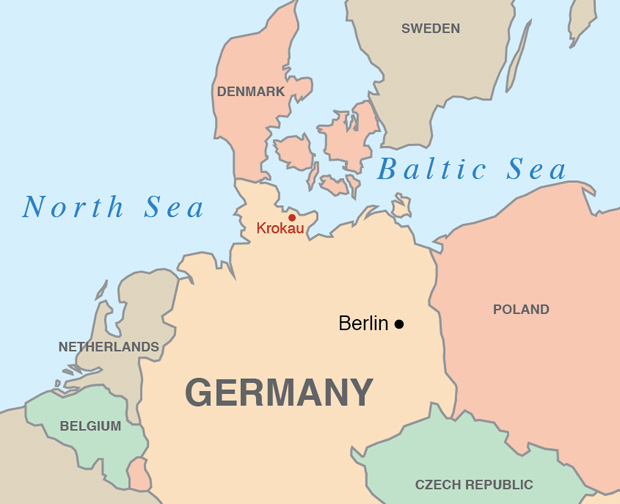
Map showing location of Krokau in Northern GermanyFrieda Möller grew up in Krokau, in a small village in the state of Schleswig-Holstein, not far from the Baltic Sea in Northern Germany. Krokau today has a population of 477 (according to Wikipedia) and I can’t imagine that it was much bigger back then.

When my grandfather, Henry, immigrated to the United States he found work as a farm hand and Krokau’s coat of arms depicts a windmill and water, so I imagine that Krokau was a coastal farming village. Since Frieda worked as a cook in a castle as a young woman, I also imagine that she had dreams of something bigger than staying on the farm. It was, after all, the 1920s during the Weimer Republic in Germany. Women were gaining more freedom. In 1918 they had even been given the right to vote.

So far all I have done is imagine what her life might have been like. It’s time to dig a little deeper. In December I won a three month’s subscription to Ancestry.com, through a charity auction put on by Solutions at Work. I think it’s time to roll up my sleeves, start asking questions, and put that subscription to use.
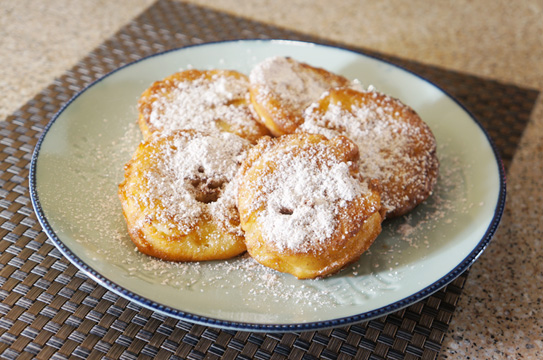

Apfel im Schlafrock (Apples in Dressing Gowns)

Apfel im Schlafrock (Apples in Dressing Gowns)

This is my first recipe from the Castle Cook’s notebook and it turned out great!

A quick Google search informed me that Apfel im Schlafrock is most commonly prepared by baking apples wrapped in pastry crust. This recipe is prepared more like a donut or an apple fritter. I was nervous about adding the Arak, which is a anise-flavored, high-octane liquor (like ouzo), and I expected them to turn out heavy, like an American donut. Instead they turned out to be elegant—not too sweet, with a delicate bite for a finish. I could imagine them being served for dessert in a high-end restaurant with whipped cream or garnished pastry cream and berry sauce.

Apfel im Schlafrock (Apples in Dressing Gowns)

2 apples, peeled, cored and cut into thick round slices (1/2 inch)
½ cup rum
1 Tbsp. arak
1/8 cup sugar
1 cup flour
½ tsp baking powder
¼ cup sugar
2/3 cup buttermilk
1 egg, beaten
5 Tbsp. butter, melted
½ tsp. vanilla
Neutrally flavored cooking oil, like canola oil
½ cup powder sugar
½ tsp. cinnamon

Peel and core the apples. Cut apples into thick round slices about (½ inch thick). Lay the slices flat in a shallow baking dish. Stir together the rum, arak, and 1/8 cup of sugar until the sugar dissolves. Pour mixture over the apple slices and let marinated for 1 hour, flipping slices a couple of times.

Make the batter. In a mixing bowl, combine the flour, sugar and baking powder. Add buttermilk, beaten egg, melted margarine and vanilla, stirring well after each addition.

Poor cooking oil in a deep fryer or cast iron skillet (enough to cover the slices—at least ½ inch).  Heat the oil to 350 degrees. Remove apple slices from the marinade and drain. Dip the apple slices into the batter, then into the hot oil. Fry, flipping once, until both sides are golden brown (1-2 minutes per side). Remove the fried apples from the hot oil with a slotted spoon or tongs and place them on an absorbent paper to drain. While still warm, sprinkle both sides with powdered sugar and cinnamon.

Apfel im Shlafrock - The Process

The process.

Translation Is Under Way

It seems that I have two conflicting New Year’s resolutions. The first is to get the cookbook translated and try it’s (hopefully) wonderful pastries recipes; the second is to lose 10 pounds. Story of my life. I love pastries and baked goods. That’s probably an understatement. It’s more like a dog seeing a squirrel when I see a Patisserie sign. Just ask my husband who graciously endured the summer I decided to improve my pie crusts by making a pie a week. That wasn’t very beneficial for our waistlines either. Well, at least I’ll stick to one of my resolutions.

The translation process has begun. It was such a surprise to have a flood of translators applying for my project. I closed the job post 20 hours after I placed it because I already had 17 candidates. Some I could eliminate right away since they weren’t native German speakers or their experience seemed limited to business translations. Others though were really intriguing.

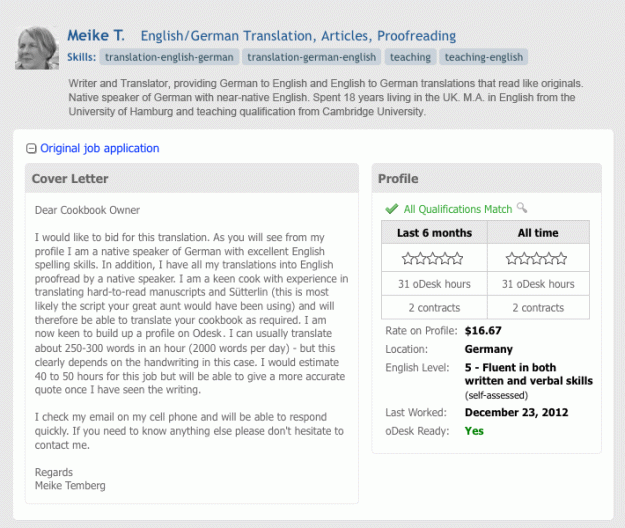
Meike's appplication to translate the cookbook.

Meike’s application.

I received these wonderfully personal letters from applicants who were also avid cooks, history buffs, and genealogists. They offered helpful translations tidbits, like the old German script is called Sütterlin and a German pound = 500 grams while an American pound= 454 grams. Ultimately the choice of translator came down to three things: 1. enthusiasm for the project, 2. ability to read the handwritten copy, and 3. a sample translation test.

The translator I selected, Meike, is terrific. Her English is top notch, she’s quick at translation, and she’s been giving me great tips as well, like the fact that German eggs were smaller in the 1920’s than the average eggs we get at the market today.

Now that I have a couple of recipes from the sample translations I thought I’d try one out this weekend. The first one that caught my eye is called Apfel im Schlafrock (literally Apples in Dressing Gown). It involves thick apple slices soaked in rum and something called arrack, then battered, fried and turned in sugar and cinnamon. New Year’s Resolution Score: cookbook resolution = 1 / diet resolution = 0.

The Internet Is An Amazing Place

I watch too much T.V. I thought I’d get that confession out of the way right up front. Inspiration, however, comes to us in unexpected ways. Sometimes the bits of your daily life intersect and an amazing idea pops out of your subconscious.

As I get older I have this nagging suspicion that I should be doing something more valuable with my time than watching T.V. That’s part of what motivated me to start this project. While organizing my home office, I found my Great-Aunt’s notebook hidden away in a stack of file folders and took a notion to find out just how much it might actually cost to translate the cookbook. I’m internet savvy. I was sure I could locate some basic information about the cost of translation online, but I had no idea how easy it would be.

I started with Craig’s List and then Ancestry.com. Both were dead ends. Craig’s List seemed to be more about selling goods than offering services and Ancestry.com’s Hire An Expert tab offered genealogy research, but not translation services. When in doubt, consult Google, right?

I did a basic Google search for “german translator”. The first page of results offered lots of “free” translations services, but those turned out to be online word translators. You know the kind—English to German, German to English. I needed an expert. A native speaker with some familiarity with old German script. Hopefully someone reasonably priced.

At the top of the 2nd page I found a paid listing for a site that looked promising: oDesk.com. oDesk.com turned out to be a digital workplace, connecting freelancers from around the world with businesses and individuals who need their services. A perfect place to find a translator with specialized skills. oDesk seemed very professional, with checks and balances to protect both parties. The process was clear and the site was easy to use, so I decided to take a leap. I posted this job:Job Posting "Translate Handwritten German Cookbook"

I had started my half–hearted search at 2:26 pm, by 2:30 pm I had found my translation service, by 3:00 pm I had created an account and posted my job offer online.  Maybe there was something I could do with this journal after all.

The Notebook

The Castle Cook's Notebook

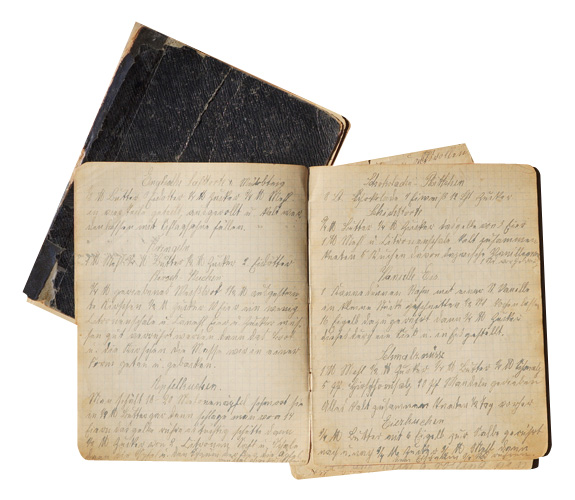
The Castle Cook’s Notebook

A few years ago my Great-Aunt Frieda passed away. I didn’t know her well. In fact, I had only met her on a couple of occasions. She immigrated to the United States from Germany before World War II and spoke with a strong German accent. That was about all I knew of her—or at least all I had taken the time to learn. I had always thought of her as old. Old world. Old fashion. Not of any consequence to me as a young American woman, trying to be grown-up and modern; to make my mark in the world.

She and her late husband didn’t have any children, so my parents acted as executors for her estate. I enjoy cooking and I venerate old publications, so my parents bequeathed me some of her old fashioned baking pans, decorating tools, cookbooks, and one thin, ragged, handwritten notebook. The notebook’s dark umber cover was cracked and flaking away from it’s backing. It was completely separated from it’s binding, held together with clear packing tape. The antique pages, lined with a light cyan grid, were yellowed and stained. To a graphic designer it was gold. Pure gold!

I was told that my great-aunt had worked in the kitchen of a German castle near her home as a young woman. There were no master cookbooks for the kitchen. Apprentice cooks were required to create a notebook of recipes as they learned. This ragged notebook from 1922 was her handwritten recipe book.

The handwriting is nearly impossible for me to read. For starters, it’s written in German. I took Spanish in high school. German might as well be Latin to me. It’s also written in old German script. Very beautiful, but not so easy to read. I think my father must have learned to write that way when he was a child. His handwriting has always been a little scrolly. I can guess from the recipe titles that she must have been a pastry cook. A few even have some lines in English, so she might have added to the book after she moved to The States.

My mom and I mused that it would be great to get it translated one day. I showed off the book to other graphic designers who cooed over it’s singularity and coveted my new find. I scanned the pages. Then I carefully packed it away—waiting for the day when I found inspiration and thought of a unique use for a such a rare treasure.