Monthly Archives: January 2013

Clues to the Castle

Providence, that’s what it was. Or fate or kismet, or coincidence…take your pick.

Last Saturday, I attended a birthday party for my sister-in-law. The guests included a couple that I had met before, but didn’t know well. As we were conversing over dinner, I explained my adventures trying to make recipes from the Castle Cook’s notebook. As fate would have it, they were not only familiar with the area where my great-aunt had lived, they had relatives there and had studied the history of the area.

Since I know nothing about the castle at this point, we speculated about what type of place this might have been and whether it might still be around. I was concerned that the castle might have been bombed or fatally damaged during World War II and no longer exist. They assured me that it was unlikely, since this part of Germany had not been bombed much during with war.

I was also told that my aunt Frieda had probably not worked at what we Americans think of as a proper castle, since those are not common in Northern Germany. It’s far more likely that she worked in a Schloss, which is often translated as castle in English, but would be more like a noble house or manor house. A Schloss would have been built for nobility or by a wealthy patron as a country estate and most certainly would have had servants. Being a big fan of PBS’s Downton Abbey, I was thrilled to hear that. I could imagine that my great-aunt Frieda was something like Daisy, young and inexperienced, wanting to improve her station in life, born into tradition but flirting with some of the new freedoms arising for women in the 1920’s.

The next day, I received an email from Lisa, the woman I had been talking with at the party. Intrigued by identifying the Schloss, she had actually done some research for me! She sent me a list of Schloss’s in the area and pointed to two she thought were good candidates: Wish-hof in Krokau (the village my great-aunt lived in) and Schloss Bredeneek, which is 20km (12 miles away). Providence has me off to a good start.
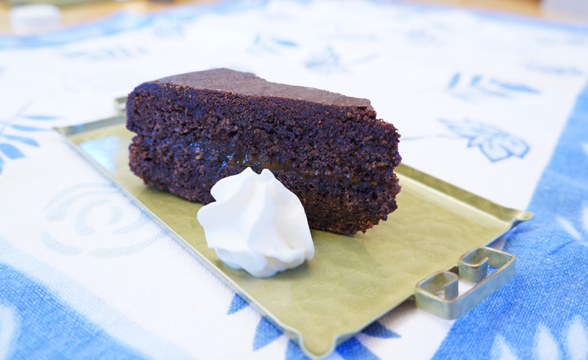

Sachertorte (Sacher Torte)

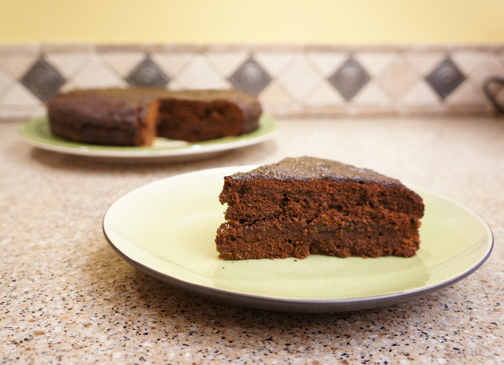
Sachertorte with whip cream

Sachertorte with whip cream

After my fourth attempt at making this torte, I can be reasonably certain I have made the recipe correctly. The batter for this torte doesn’t rise very much, resulting in a rich, intense, dark chocolate cake. I made it in a 9″ springform pan, but I am recommending making it in a 8″ pan to make the torte a little taller. Although this recipe didn’t specifically call for apricot filling between the layers of cake, my research indicated that the apricot filling was a key to the identity of a Sachertorte, so I included it.

Sachertorte (Sacher Torte)

Cake:
1 cup butter
1 cup granulated sugar
7 eggs, separated
7 oz. softened unsweetened baking chocolate (7 squares)
3/4 tsp. lemon juice
3/4 tsp. vanilla sugar (or substitute regular sugar)
1 cup sifted cake flour

Filling:
6 oz. apricot jam
Water (to thin the jam to a spreadable consistency)

Glaze:
1-1/2 cups granulated sugar
3/4 cup water
6 oz. softened unsweetened baking chocolate (6 squares)

Place wax paper at the bottom of an 8″ springform pan, then butter and lightly flour the bottom and sides of the pan. Preheat oven to 350°F.

In a double boiler, melt the chocolate for the cake. Remove from heat and let cool while you beat the butter and sugar in a large mixing bowl. When butter and sugar are creamed, add egg yolks one at a time, beating well after each addition. Drizzle melted chocolate into the batter, stirring constantly. Once chocolate is mixed in, set aside.

In a separate bowl, beat egg whites. When egg whites begin to froth, drizzle lemon juice into the eggs, beating all the while. When egg whites achieve soft peaks, add the vanilla sugar. Continue beating until the egg whites create stiff peaks.

First, fold 1/3 of the beaten egg whites into the chocolate batter, then fold in 1/3 of the flour. Continue alternating egg whites and flour, until completely incorporated into the chocolate mixture. Do not over mix. Pour batter into the springform pan and cook in a 350°F oven for 45-55 minutes or until a toothpick inserted in the center comes out clean. Remove cake from oven. Let rest for 10 minutes, then remove the springform ring and let cake cool on a wire rack. Cool completely before glazing.

When cake completely cooled, cut the thin top crust off the cake to level. Then slice the cake in half horizontally. Remove the top half of the cake. Mix enough water into the apricot jam to make it spreadable. Cover the top of the lower layer with the apricot jam. Then reposition the top layer on the cake.

To make the glaze, combine 3/4 cup water and 1-1/2 cups sugar in a sauce pan. Heat to boiling and boil gently for 15 minutes, stirring constantly, until the sugar is completely dissolved. Add 6 oz. of baking chocolate and continue boiling until glaze begins to thicken and the graininess disappears from the chocolate (another 10-15 minutes). Remove from heat. Cool slightly (1 minute).

Place cake on wire rack over wax paper. Pour glaze over the cake, starting around the top edges and working inward to the center of the cake. Use a flat icing spatula to help covering the sides as the chocolate glaze pours over the edges. Cool completely.

Slice thin into thin wedges and serve with a dollop of whip cream.

Sachertorte–The Process

The Process.


Sachertorte – Failed Attempts 1&2

Sachertorte_failed-attempts1and2

The cake didn’t rise in my first two attempts at making a Sachertorte. It tasted fine, but it was dense like a brownie.

Since I started receiving the translations, I have come to realize that the recipes in the Castle Cook’s notebook are more like cook’s shorthand than full blown recipes. For instance, here’s the translation for the recipe I tried this weekend:

Sachertorte
250 g butter
200 g sugar
8 eggs
200 g softened chocolate
1 spoon lemon juice
1 spoon vanilla sugar
120 g flour
Stir for 15 minutes. […] the foam of 6 eggs under, bake for 1 hour, chocolate filling over, whipped cream as well.

With just bare bones to start from, there is a lot of room for interpretation. Some parts are easy. It’s easy to convert metric measurement to U.S. equivalents. I also know that eggs were smaller in the 1920’s, so I can reduce the amount of eggs. From experience and by looking at similar recipes, I can make a decent guess at cooking instructions and even know what the finished product should look like.

The tricky part comes when there are ingredients that don’t seem to fit. In this case, lemon juice and vanilla sugar. I took a guess that they were unique flavorings, so I mixed them in the batter before I folded in the beaten egg whites. Wrong! My cake didn’t rise. I even tried it again, just to make sure I hadn’t made some baking faux pas. Same disappointing result. Both cakes were stunted and dense, which is great if you are trying to make brownies, but discouraging if you were hoping to end up with a cake. Back to the internet for a little research.

I found this site called Baking 911. It’s full of baking techniques and baking science. A little like Myth Busters for baking. What I discovered is that the lemon juice and vanilla sugar should have been added while beating the egg whites. Sugar helps stablize beaten egg whites and an acid, like lemon juice, helps prevent overbeating. I guess it’s back to the kitchen for me…

Who Was The Castle Cook?

My parents recently celebrated their 50th wedding anniversary. In preparation for the big event, I asked my mom to send me family photos so I could prepare a memory book. Along with photos of camping trips, family reunions, and me in the bathtub when I was 2, came a bunch of old family photos—including this one of my dad’s grandparents and their family in front of their home in Germany in the 1920s.

Frieda and family c. 1927

Frieda Möeller (on right) with her parents, Magdelena and Ferdinand, an uncle, and her brother Henry, in front of their cottage in Krokaw, Germany. c. 1927.

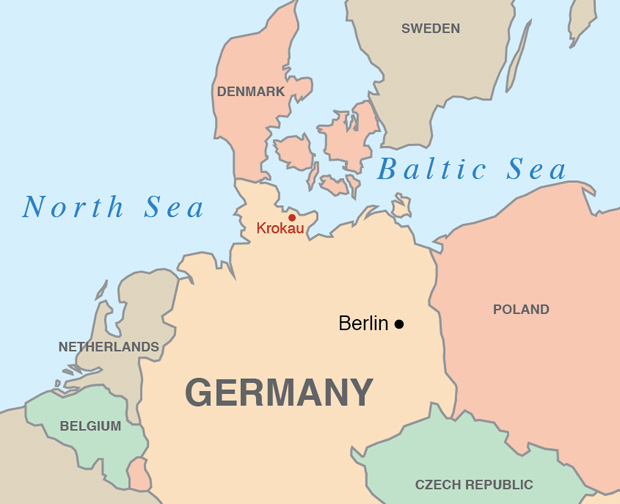
Map showing location of Krokau in Northern GermanyFrieda Möller grew up in Krokau, in a small village in the state of Schleswig-Holstein, not far from the Baltic Sea in Northern Germany. Krokau today has a population of 477 (according to Wikipedia) and I can’t imagine that it was much bigger back then.

When my grandfather, Henry, immigrated to the United States he found work as a farm hand and Krokau’s coat of arms depicts a windmill and water, so I imagine that Krokau was a coastal farming village. Since Frieda worked as a cook in a castle as a young woman, I also imagine that she had dreams of something bigger than staying on the farm. It was, after all, the 1920s during the Weimer Republic in Germany. Women were gaining more freedom. In 1918 they had even been given the right to vote.

So far all I have done is imagine what her life might have been like. It’s time to dig a little deeper. In December I won a three month’s subscription to Ancestry.com, through a charity auction put on by Solutions at Work. I think it’s time to roll up my sleeves, start asking questions, and put that subscription to use.

Apfel im Schlafrock (Apples in Dressing Gowns)

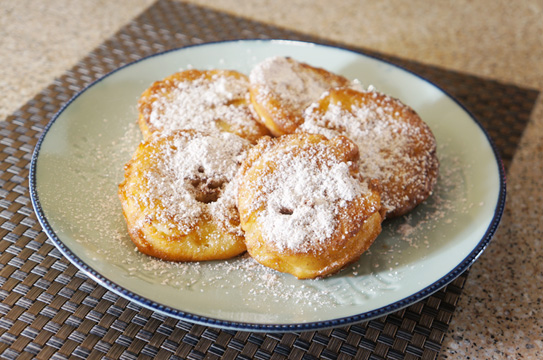
Apfel im Schlafrock (Apples in Dressing Gowns)

This is my first recipe from the Castle Cook’s notebook and it turned out great!

A quick Google search informed me that Apfel im Schlafrock is most commonly prepared by baking apples wrapped in pastry crust. This recipe is prepared more like a donut or an apple fritter. I was nervous about adding the Arak, which is a anise-flavored, high-octane liquor (like ouzo), and I expected them to turn out heavy, like an American donut. Instead they turned out to be elegant—not too sweet, with a delicate bite for a finish. I could imagine them being served for dessert in a high-end restaurant with whipped cream or garnished pastry cream and berry sauce.

Apfel im Schlafrock (Apples in Dressing Gowns)

2 apples, peeled, cored and cut into thick round slices (1/2 inch)
½ cup rum
1 Tbsp. arak
1/8 cup sugar
1 cup flour
½ tsp baking powder
¼ cup sugar
2/3 cup buttermilk
1 egg, beaten
5 Tbsp. butter, melted
½ tsp. vanilla
Neutrally flavored cooking oil, like canola oil
½ cup powder sugar
½ tsp. cinnamon

Peel and core the apples. Cut apples into thick round slices about (½ inch thick). Lay the slices flat in a shallow baking dish. Stir together the rum, arak, and 1/8 cup of sugar until the sugar dissolves. Pour mixture over the apple slices and let marinated for 1 hour, flipping slices a couple of times.

Make the batter. In a mixing bowl, combine the flour, sugar and baking powder. Add buttermilk, beaten egg, melted margarine and vanilla, stirring well after each addition.

Poor cooking oil in a deep fryer or cast iron skillet (enough to cover the slices—at least ½ inch).  Heat the oil to 350 degrees. Remove apple slices from the marinade and drain. Dip the apple slices into the batter, then into the hot oil. Fry, flipping once, until both sides are golden brown (1-2 minutes per side). Remove the fried apples from the hot oil with a slotted spoon or tongs and place them on an absorbent paper to drain. While still warm, sprinkle both sides with powdered sugar and cinnamon.

Apfel im Shlafrock - The Process

The process.

Translation Is Under Way

It seems that I have two conflicting New Year’s resolutions. The first is to get the cookbook translated and try it’s (hopefully) wonderful pastries recipes; the second is to lose 10 pounds. Story of my life. I love pastries and baked goods. That’s probably an understatement. It’s more like a dog seeing a squirrel when I see a Patisserie sign. Just ask my husband who graciously endured the summer I decided to improve my pie crusts by making a pie a week. That wasn’t very beneficial for our waistlines either. Well, at least I’ll stick to one of my resolutions.

The translation process has begun. It was such a surprise to have a flood of translators applying for my project. I closed the job post 20 hours after I placed it because I already had 17 candidates. Some I could eliminate right away since they weren’t native German speakers or their experience seemed limited to business translations. Others though were really intriguing.

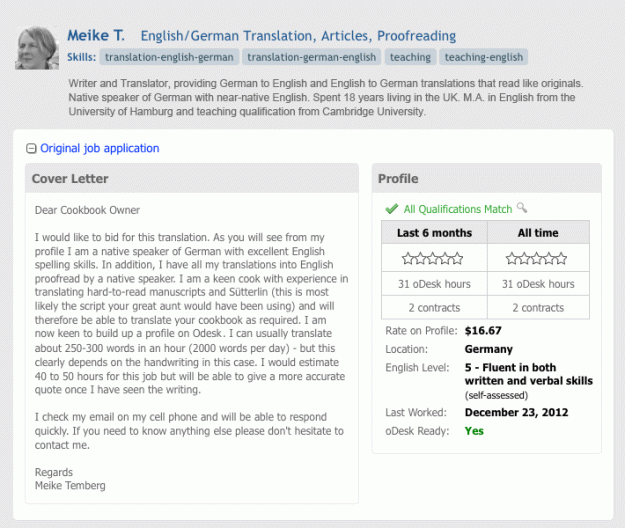
Meike's appplication to translate the cookbook.

Meike’s application.

I received these wonderfully personal letters from applicants who were also avid cooks, history buffs, and genealogists. They offered helpful translations tidbits, like the old German script is called Sütterlin and a German pound = 500 grams while an American pound= 454 grams. Ultimately the choice of translator came down to three things: 1. enthusiasm for the project, 2. ability to read the handwritten copy, and 3. a sample translation test.

The translator I selected, Meike, is terrific. Her English is top notch, she’s quick at translation, and she’s been giving me great tips as well, like the fact that German eggs were smaller in the 1920’s than the average eggs we get at the market today.

Now that I have a couple of recipes from the sample translations I thought I’d try one out this weekend. The first one that caught my eye is called Apfel im Schlafrock (literally Apples in Dressing Gown). It involves thick apple slices soaked in rum and something called arrack, then battered, fried and turned in sugar and cinnamon. New Year’s Resolution Score: cookbook resolution = 1 / diet resolution = 0.

The Internet Is An Amazing Place

I watch too much T.V. I thought I’d get that confession out of the way right up front. Inspiration, however, comes to us in unexpected ways. Sometimes the bits of your daily life intersect and an amazing idea pops out of your subconscious.

As I get older I have this nagging suspicion that I should be doing something more valuable with my time than watching T.V. That’s part of what motivated me to start this project. While organizing my home office, I found my Great-Aunt’s notebook hidden away in a stack of file folders and took a notion to find out just how much it might actually cost to translate the cookbook. I’m internet savvy. I was sure I could locate some basic information about the cost of translation online, but I had no idea how easy it would be.

I started with Craig’s List and then Ancestry.com. Both were dead ends. Craig’s List seemed to be more about selling goods than offering services and Ancestry.com’s Hire An Expert tab offered genealogy research, but not translation services. When in doubt, consult Google, right?

I did a basic Google search for “german translator”. The first page of results offered lots of “free” translations services, but those turned out to be online word translators. You know the kind—English to German, German to English. I needed an expert. A native speaker with some familiarity with old German script. Hopefully someone reasonably priced.

At the top of the 2nd page I found a paid listing for a site that looked promising: oDesk.com. oDesk.com turned out to be a digital workplace, connecting freelancers from around the world with businesses and individuals who need their services. A perfect place to find a translator with specialized skills. oDesk seemed very professional, with checks and balances to protect both parties. The process was clear and the site was easy to use, so I decided to take a leap. I posted this job:Job Posting "Translate Handwritten German Cookbook"

I had started my half–hearted search at 2:26 pm, by 2:30 pm I had found my translation service, by 3:00 pm I had created an account and posted my job offer online.  Maybe there was something I could do with this journal after all.